Fitting Strength Training Into 30 Minutes

Thirty minutes is enough to get stronger. You can’t do everything in that time, so the job is to keep the work that matters and cut the rest. Three focused half-hour sessions a week will beat one long session you keep skipping.
What to keep
In a short session, protect these:
- One or two big compound lifts. Squats, hinges, presses, and rows do the most work per minute. They’re the reason you’re there.
- Hard sets. Every working set should end with only a couple of reps left in the tank. Short sessions have no room for easy filler sets.
- Enough rest on the big lifts. Cutting rest to two minutes or less on heavy work costs you reps. Find time elsewhere.
What to cut
- Long warm-ups. Skip the 15 minutes of general cardio. Do two or three light, quick sets of your first exercise instead. They warm up exactly what you’re about to use.
- Extra exercises. Four exercises is plenty. A fifth and sixth usually mean every exercise gets less effort.
- Extra sets. Two or three hard working sets per exercise is enough in a 30-minute session. Over a week of short sessions it adds up.
- Wandering. Set up your stations before you start, and keep your phone for logging and timing.
Pair exercises that don’t compete
The biggest time-saver is alternating two exercises that use different muscles. Do a set of one, rest briefly, do a set of the other, rest briefly, and repeat. Each muscle gets its full rest while you work the other.
Good pairs:
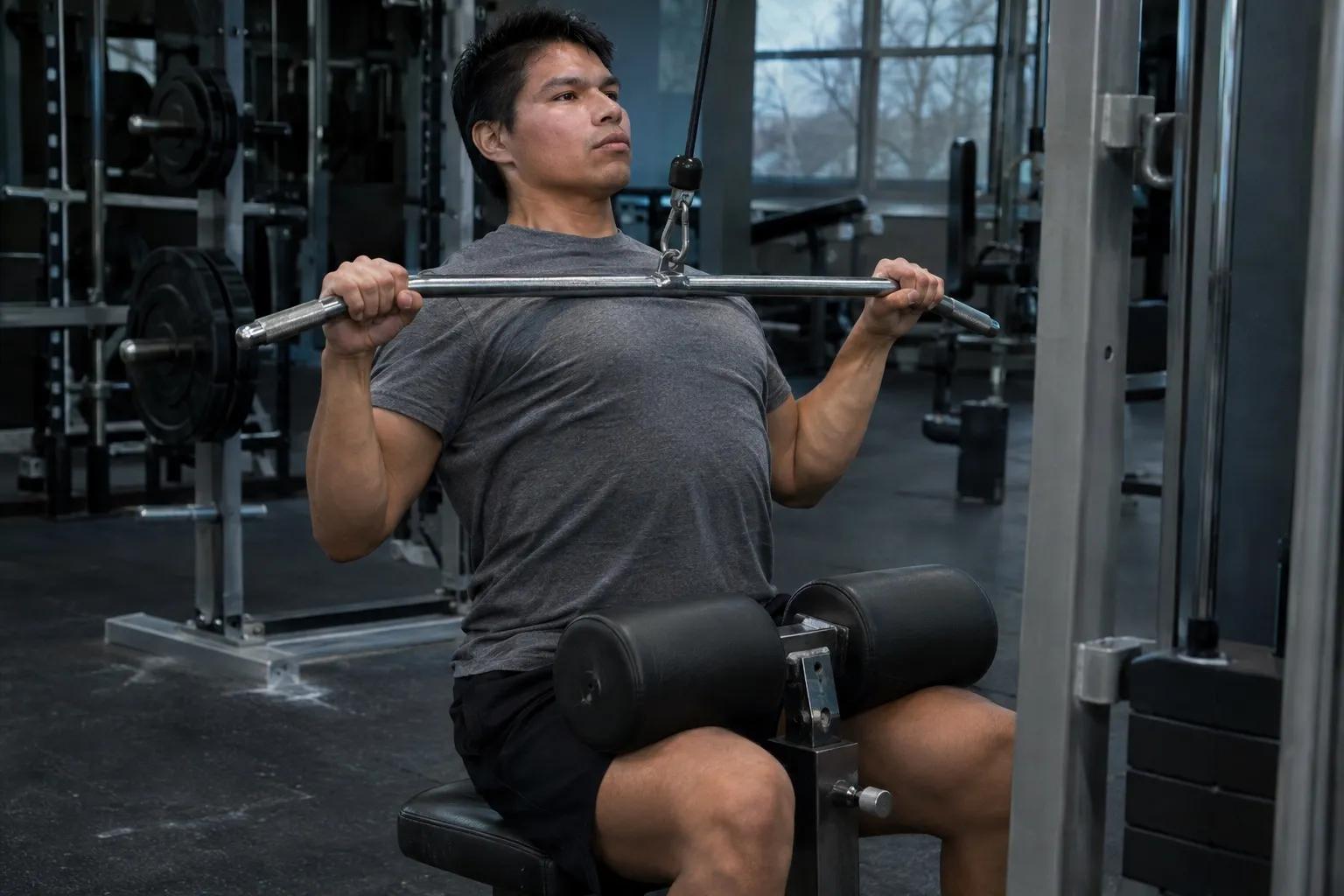
- A push and a pull: dumbbell bench press with a one-arm row, or an overhead press with a lat pulldown.
- A lower-body and an upper-body exercise: a split squat with a push-up.
- Two small exercises: a curl with a calf raise.
Keep your heaviest lift on its own, especially a squat or deadlift. Pairing it with something demanding can tire your grip, your breathing, or your back before the main work. Pair the exercises that come after it.
In a busy gym, pick pairs you can do in one spot, like two dumbbell exercises at one bench, so you’re not waiting for equipment.
How the 30 minutes break down
A typical short session looks like this:
| Minutes | What you’re doing |
|---|---|
| 0–5 | Warm-up sets of your first lift |
| 5–15 | Main lift: 3 working sets, about 2½ minutes apart |
| 15–25 | Pair 1: two exercises alternated, 2 or 3 rounds |
| 25–30 | Pair 2 or one finisher, such as a plank or curls |
If you’re running behind, drop the last pair. Don’t rush the main lift to save it.
Two sample sessions
Run them alternately, two or three times a week, with a day off between sessions when you can.
Session A
| Exercise | Sets × reps |
|---|---|
| Goblet squat or back squat | Warm-up, then 3 × 6–8 |
| Dumbbell bench press, paired with a one-arm dumbbell row | 3 × 8–10 each |
| Plank, paired with a dumbbell curl | 2 × 30 seconds, 2 × 10–12 |
Session B
| Exercise | Sets × reps |
|---|---|
| Romanian deadlift | Warm-up, then 3 × 6–8 |
| Seated dumbbell overhead press, paired with a lat pulldown | 3 × 8–10 each |
| Split squat, paired with a calf raise | 2 × 8–10 per leg, 2 × 12–15 |
Use the same progression as any program: when you hit the top of the rep range on every set, add a little weight next time.
When 30 minutes is your only option
Short sessions work best as a routine, not a fallback. Three 30-minute sessions a week give you about 90 minutes of focused lifting, which is enough to keep progressing for a long time.
If you also run or play a sport, short sessions are often the best fit. Planning lifting around running and sports covers where to put them in the week.
If some days you only have 15 minutes, do just the main lift and one pair. Something done beats a full session skipped.
The short version
- Keep one or two big lifts, hard sets, and real rest on the heavy work.
- Cut the long warm-up, extra exercises, and filler sets.
- Pair exercises that don’t compete to save time, but keep your heaviest lift on its own.
- If you run short, drop the last pair instead of rushing the main lift.